
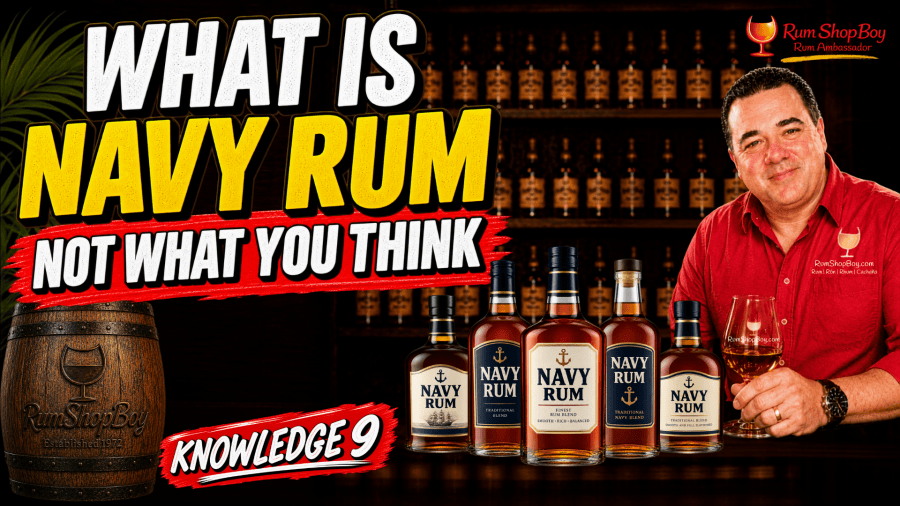
What exactly is Navy Rum?
- Is it a particular style?
- Does it have to be strong?
- Does it have to come from certain countries?
- And does it actually have anything to do with the Royal Navy?
Well… yes.
But probably not in quite the way you think.
Navy Rum has a fascinating history stretching back hundreds of years. But today, the words “Navy Rum” on a bottle don’t define one precise, tightly regulated category.
To understand what they do mean, we need to go back to the days when rum was part of everyday life in the British Royal Navy.
🥃 Why Did the Royal Navy Drink Rum?
Alcohol was a normal part of life at sea. Beer and, later, spirits formed part of a sailor’s daily provisions. But beer was bulky and didn’t always survive particularly well on long voyages.
Stronger spirits were much more practical. Brandy was commonly used, but as Britain’s presence in the Caribbean expanded, rum became increasingly available. During the 17th century, rum began replacing brandy as the spirit associated with the Royal Navy.
Eventually, the daily rum ration became one of the most famous traditions in British naval history.
But that doesn’t mean there was one particular distillery making something called “Royal Navy Rum.”
🥃 There Wasn’t One Royal Navy Rum
The Royal Navy required enormous quantities of spirit. That rum could come from different parts of the Caribbean rather than one particular country, island or distillery. Historically, rums associated with places such as Guyana, Jamaica and Trinidad, along with other Caribbean producers, could be brought together.
This meant that Navy Rum developed around blending.
- Different rums.
- Different origins.
- Different flavour profiles.
Combined to create a consistent final product.
And that blending tradition helps explain the distinctive character we now associate with traditional Navy-style rum.
🥃 What Created the Navy Rum Character?
Different Caribbean rum traditions could contribute different characteristics to the blend.
Rum from Guyana could provide rich, heavy Demerara character.
Jamaican rum could contribute fruit, esters and funk.
Other, lighter rums could provide balance.
The objective wasn’t necessarily to showcase the character of one distillery or one country. It was about creating a blend with consistency, body and character. That distinction remains important when looking at bottles described as Navy Rum today.
🥃 What Is Navy Strength Rum?
This is where things can become confusing.
You’ll often hear several terms:
- Navy Rum.
- Navy Strength.
- Navy Proof.
- Gunpowder Proof.
Gunpowder Proof.
They’re sometimes used as though they all mean exactly the same thing.
They don’t necessarily.
One of the most famous stories surrounding naval rum is that sailors would mix rum with gunpowder and attempt to ignite it.
If the gunpowder still burned, the rum was supposedly “proof” that it hadn’t been watered down.
There is historical basis for the relationship between spirits, gunpowder and the concept of proof, although the romantic image of sailors routinely testing every daily ration is probably rather neater than the real history.
What we do know is that the Royal Navy issued rum at substantial strength. Under the traditional British proof system, 100 proof corresponded to approximately 57.1% ABV. That’s why you’ll frequently see 57% or 57.1% ABV associated with the modern term “Navy Strength”.
But there’s an important qualification.
Traditional Royal Navy rum wasn’t necessarily issued at exactly 57.1% ABV throughout its entire history. The strength of the ration and how it was managed changed over time.
So saying:
“Navy Rum must be 57% ABV.”
…is too simplistic.
🥃 Is Navy Rum the Same as Grog?
No.
Navy Rum was the spirit. Grog was the diluted drink.
During the 18th century, Admiral Edward Vernon ordered that sailors’ rum ration should be diluted with water. That mixture became associated with the name grog. So although the two are closely connected historically, they’re not simply two names for the same thing.
🥃 What Was Black Tot Day?
Remarkably, the Royal Navy’s rum ration survived well into the 20th century. But naval life had changed dramatically. Ships, weapons, machinery and sailors’ responsibilities had become increasingly sophisticated, making a daily alcohol ration rather more difficult to justify.
On 31 July 1970, the Royal Navy’s daily rum ration finally ended.
The date became known as Black Tot Day.
After more than three centuries, one of the Royal Navy’s most famous traditions was over. Its influence on rum, however, certainly wasn’t.
🥃 What Does Navy Rum Mean Today?
This is perhaps the most important point.
Navy Rum isn’t a tightly regulated global rum category.
- There isn’t one recipe.
- There isn’t one country of origin.
- There isn’t one specific type of still.
- And there isn’t one universally required bottling strength.
Today, “Navy Rum” generally tells you something about the style and tradition the producer is trying to evoke.
That might mean a blend of rums from several Caribbean countries. It might mean a richer, heavier flavour profile. It might mean a higher bottling strength.
But not necessarily.
That’s why it’s worth looking beyond the words on the front of the bottle.
🥃 Black Tot and the Navy Rum Tradition
Black Tot Finest Caribbean is a good modern example of how the historic blending philosophy continues to influence rum.
Its name clearly references the Royal Navy tradition, while its blend brings together rum from:
- Guyana.
- Barbados.
- Trinidad.
- Jamaica.
Different Caribbean rum traditions brought together into one blend.
That has a clear connection with the blending philosophy historically associated with Royal Navy rum.
🥃 What About Pusser’s?
Then there’s Pusser’s, a brand deliberately built around the heritage of the Royal Navy rum ration.
It’s another example of how naval rum history continues to influence the bottles we see today.
But that doesn’t mean every bottle using terms such as Navy Rum, Navy Strength, Gunpowder Proof or Navy Style is describing exactly the same thing.
The words alone don’t define the rum.
🥃 Look Beyond the Label
So if you pick up a bottle labelled NAVY RUM, don’t stop at the words on the front.
- Turn the bottle around.
- Find out where the rum comes from.
- Is it a blend?
- Which countries are represented?
- What stills were used?
- What strength is it bottled at?
And perhaps most importantly:
What does the producer actually mean when they call it Navy Rum?
Because Navy Rum isn’t really one precise type of rum. It’s a style built around a fascinating historical tradition.
A tradition of blending different Caribbean rum styles to create something rich, consistent and full of character.
The Royal Navy stopped issuing its daily rum ration more than 50 years ago. But the influence of that tradition is still sitting on rum shelves today.
📺 Watch Rum Knowledge #9
What Is Navy Rum? The History Behind the Name | Rum Knowledge #9
💬 What Do You Think?
When you hear the words “Navy Rum”, what bottle immediately comes to mind?
- Black Tot?
- Pusser’s?
- Or something completely different?
- And do you think the term “Navy Rum” is useful today, or has it become too loosely defined?
Let me know what you think.
If you enjoy learning more about what is actually in your glass, please subscribe to RumShopBoy on YouTube for more Rum Knowledge, reviews and recommendations.
🍹 Drink More Rum!


