
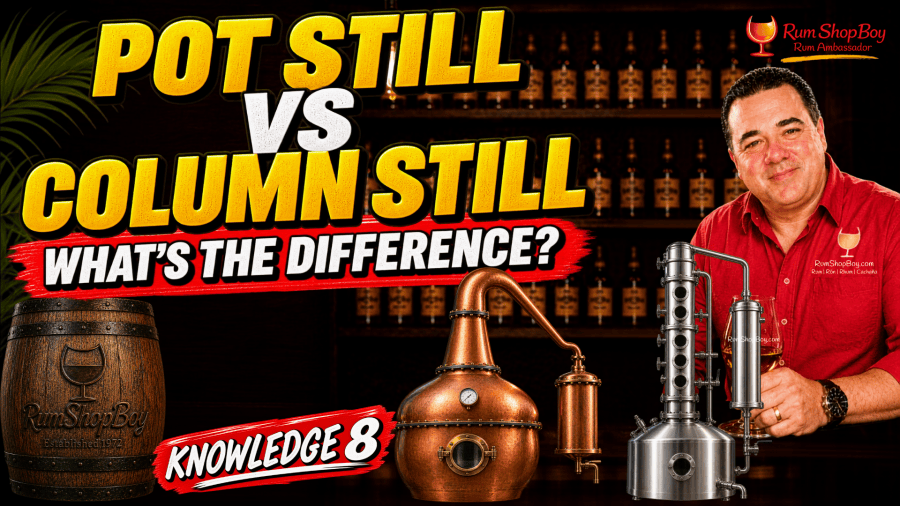
Pot still rum is better than column still rum.
Right?
Well… not necessarily.
It’s one of the biggest misconceptions in rum: that simply knowing which type of still was used tells you whether a rum is going to be good.
It doesn’t.
Pot stills and column stills can certainly produce very different styles of spirit. But the still is only one part of a much bigger production process.
So what is the difference between a pot still and a column still? And does one really make better rum?
🥃 What Does Distillation Actually Do?
Fermentation creates alcohol, but it also creates a huge number of flavour compounds.
Distillation allows a producer to separate and concentrate different parts of that fermented liquid.
How that distillation is carried out can have a significant influence on the character of the spirit that eventually comes off the still.
And that’s where pot and column stills begin to differ.
🥃 How Does a Pot Still Work?
A pot still is probably what most people picture when they think about traditional distillation.
Fermented liquid is placed into the still and heated. Alcohol and other volatile compounds evaporate, those vapours are collected and condensed, and the resulting liquid becomes the distilled spirit.
Once the distillation is complete, the still has to be emptied and the process starts again.
Pot distillation is a batch process.
Pot stills generally produce heavier, more characterful spirits and can retain more of the flavour compounds created during fermentation.
That can mean:
Fruit. Esters. Spice. Earthiness. And sometimes some seriously funky flavours.
Think about distilleries such as Hampden and Worthy Park in Jamaica, or some of the heavier components produced by Appleton Estate.
Those big flavours aren’t created by the pot still alone — fermentation plays an enormous role — but the way the spirit is distilled helps determine how much of that character makes it through into the final distillate.
🥃 How Does a Column Still Work?
Unlike a traditional pot still, a column still can operate continuously.
Fermented liquid enters the column and the alcohol and other compounds are separated as they pass through different levels of the still.
Production can therefore continue without having to stop and restart after every batch.
That makes column distillation considerably more efficient.
But there’s an important distinction to make:
Efficient doesn’t mean bad.
Column stills can produce lighter, cleaner and often higher-strength spirits.
But that doesn’t mean all column still rum tastes the same — or that column still rum has no flavour.
🥃 Not All Column Stills Are The Same
This is where the simple idea of “pot still good, column still bad” really begins to fall apart.
Column stills aren’t all the same.
Their design, the number of columns, where the spirit is collected and the strength at which the spirit is distilled can all influence how much character remains in the distillate.
How the producer operates the still matters enormously.
So saying “column still rum has no flavour” simply isn’t true.
🥃 Why Choose? Some Producers Use Both
Some of the world’s great rum producers don’t choose between pot and column stills.
They use both.
Appleton Estate, for example, produces both pot still and column still distillates.
Those different styles of spirit can then be blended together. The heavier pot still components can contribute character and complexity, while lighter column still components can help provide balance and structure.
Foursquare in Barbados also uses both a double-retort pot still and a twin-column still.
Many Foursquare rums combine distillates from both.
And that brings us to an important rum term.
🥃 What Is a Single Blended Rum?
You may have seen the term Single Blended Rum used to describe certain rums.
It can sound contradictory at first.
How can something be both “single” and “blended”?
Single means the rum has been produced at one distillery.
Blended refers to the use of both traditional pot still and traditional column still distillates.
Something such as Foursquare Exceptional Cask Selection 2011 is a great example.
Different distillates bring different characteristics, which can then be brought together to create the finished rum.
Rather than one method automatically being superior, the blender has a larger palette of flavours and characteristics to work with.
🥃 Pot Still Doesn’t Automatically Mean Better
A pot still doesn’t automatically make great rum.
And a column still doesn’t automatically make bad rum.
There are far more questions we should be asking.
- What was the raw material?
- How was it fermented?
- How long was the fermentation?
- How was the still operated?
- At what strength was the spirit distilled?
- Was it aged?
- Where was it aged?
- What type of cask was used?
- Was the final rum a blend of several different distillates?
All of these things can affect what eventually ends up in your glass.
The type of still matters.
But it doesn’t exist in isolation.
🥃 A Column Still… Made From Wood?
There’s another reason I don’t like dismissing column-distilled rum. Some column stills are an important part of rum history.
Guyana provides one of the best examples.
Diamond Distillery still operates historic stills associated with the old Demerara estates, including the famous wooden Coffey still originally associated with Enmore.
Yes.
A column still made from wood.
It produces a distinctive style of spirit that can become a component in Demerara rum blends.
So much for the idea that column still rum can’t have character.
🥃 Pot Still vs Column Still: Which Is Better?
Neither.
They’re different tools capable of producing different results.
A pot still can produce big, heavy and characterful rum.
A column still can produce lighter and cleaner rum.
But depending on its design and how it is operated, a column still can also produce plenty of character. And when a producer combines different styles of distillate, the blender has an enormous range of flavours and characteristics available.
So the next time you see POT STILL written proudly across a bottle, don’t automatically assume that means the rum is better.
And don’t dismiss another rum simply because it came from a column still.
Instead, look beyond the still and ask how the spirit was actually made.
Because when it comes to rum, the interesting question isn’t always:
“Which still did they use?”
It’s:
“What did they do with it?”
📺 Watch Rum Knowledge #8
Pot Still vs Column Still: What’s The Difference? | Rum Knowledge #8
💬 What Do You Think?
Do you have a preference?
Do you love the big, heavy character often associated with pot still rum?
Do you enjoy lighter column-distilled styles?
Or do you think producers such as Foursquare and Appleton Estate demonstrate just how well the two can work together?
Let me know what you think.
And if you enjoy learning more about what is actually in your glass, subscribe to RumShopBoy on YouTube for more Rum Knowledge, reviews and recommendations.
🍹 Drink More Rum!


