
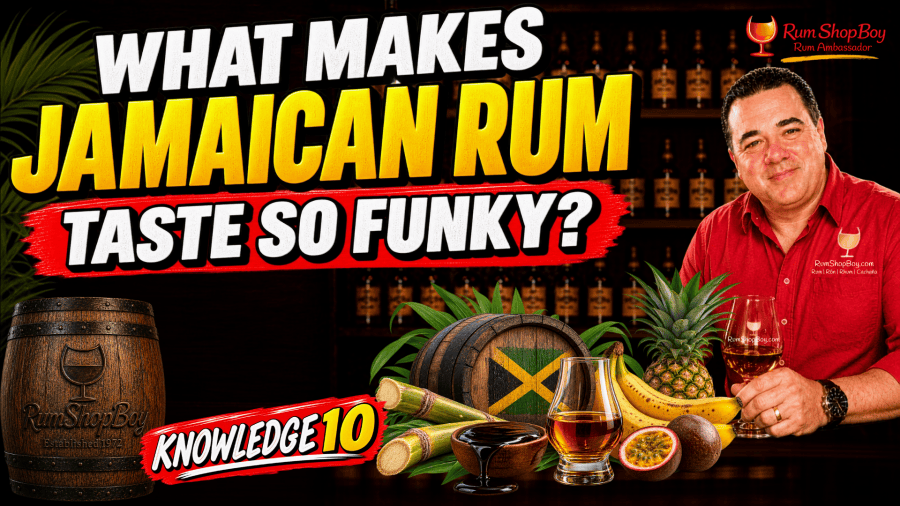
Overripe bananas. Tropical fruit. Fermented fruit. And sometimes aromas that are almost impossible to describe.
If you’ve ever opened a particularly characterful Jamaican rum, you’ll probably know exactly what I’m talking about.
It’s what rum enthusiasts often call Jamaican funk.
Some people absolutely love it.
Others find it a little challenging.
But where does that distinctive character actually come from?
Is it the pot still? The fermentation? The yeast? Or something rather more unusual?
The answer is a fascinating combination of production methods, chemistry and Jamaican rum-making tradition.
And importantly, not all Jamaican rum is equally funky.
🥃 What Is Jamaican Rum Funk?
Jamaican funk isn’t a formal technical classification.
It’s a term rum enthusiasts use to describe the intense, often fruity and sometimes unusual aromas associated with certain Jamaican rums.
Depending on the rum, you might encounter:
- Overripe banana and pineapple
- Fermented tropical fruit
- Solvent-like or nail-varnish aromas
- Rich, earthy and sometimes savoury notes
- Powerful, complex fruity flavours
Those solvent-like aromas might sound rather unappealing when written down!
But in the right balance, they can contribute to an extraordinarily complex and enjoyable spirit.
Distilleries such as Hampden Estate and Worthy Park demonstrate just how distinctive Jamaican rum can be.
So what creates those flavours?
🥃 It All Starts With Fermentation
One of the biggest misconceptions about Jamaican funk is that it comes entirely from pot still distillation.
But much of the story begins before the fermented liquid ever reaches the still.
Fermentation is absolutely fundamental to rum’s flavour.
Yeast converts sugars into alcohol, but fermentation also creates numerous other compounds. Bacteria can also influence the chemistry of the fermentation, including the production of organic acids. The yeast strains, fermentation conditions, duration and microbial activity can all affect the character of the fermented liquid.
And that gives the distiller the foundation for the flavours that may eventually appear in the rum.
This is one reason fermentation deserves far more attention when we talk about rum production.
🥃 What Are Esters?
If you’re interested in Jamaican rum, you’ve probably heard the word esters.
Esters are chemical compounds formed through reactions involving alcohols and acids.
Many esters have distinctive fruity aromas. Depending on the compounds and their concentrations, they can contribute aromas reminiscent of bananas, pineapple, pears and other fruits. Some can also have solvent-like characteristics.
Esters are an important part of what makes certain Jamaican rums so distinctive.
But there’s an important distinction.
A rum’s ester content doesn’t automatically tell you whether you’ll enjoy drinking it. A higher ester level can produce a more intense aromatic profile, but balance, individual compounds and personal preference still matter.
More esters doesn’t automatically mean better rum.
🥃 What Is Dunder in Jamaican Rum?
Here’s where Jamaican rum production becomes particularly interesting.
Dunder is the liquid residue remaining after rum distillation.
In some traditional Jamaican production methods, dunder can be reused as part of the fermentation process. Depending on how it is handled, it can contribute to the chemical and microbial environment involved in producing certain styles of rum.
But dunder isn’t some magical ingredient that automatically creates Jamaican funk.
Its role depends on the producer and the particular production method.
And not every Jamaican distillery uses dunder in the same way.
🥃 What Is Muck?
Muck is another term frequently associated with high-ester Jamaican rum.
It’s particularly connected with certain traditional fermentation practices used to create intensely characterful distillates.
In simplified terms, muck involves microbially active material that can help generate organic acids used in high-ester rum production. Those acids can subsequently contribute to the formation of esters.
The processes involved can be complex and vary between producers.
Muck isn’t a requirement for Jamaican rum, and it isn’t used by every Jamaican distillery.
But it helps explain how some producers can create extraordinarily aromatic, high-ester spirits.
🥃 Does Pot Still Distillation Create Jamaican Funk?
Pot stills are closely associated with some of Jamaica’s most characterful rums.
They can produce heavier distillates that retain substantial amounts of the compounds developed during fermentation.
But the pot still doesn’t create all those flavours from nothing. Much of the foundation has already been established during fermentation. The design and operation of the still then influence which compounds carry through into the spirit and in what concentrations.
That’s why simply saying “Jamaican rum is funky because it’s pot distilled” misses an important part of the story.
Column stills also play a significant role in Jamaican rum production.
And many Jamaican rums combine different styles of distillate.
The still matters, but it’s only one part of the process.
🥃 Hampden Estate and Worthy Park
Two names you’ll frequently encounter when exploring Jamaican rum are Hampden Estate and Worthy Park.
Hampden Estate is particularly well known for producing intensely aromatic pot still rums, including high-ester expressions.
Its different rum marques demonstrate how fermentation and production choices can create a range of flavour profiles.
Worthy Park also produces distinctive Jamaican pot still rum, with its own fermentation and distillation approach.
Both are excellent examples of why it’s worth looking beyond the country of origin and understanding the individual distillery.
They demonstrate that even within Jamaica, rum can vary enormously.
🥃 Are All Jamaican Rums Funky?
No.
And this is an important point.
Jamaica produces a wide range of rum styles.
Some are intensely aromatic, high-ester spirits. Others are considerably more restrained. Fermentation methods, still types, blending and maturation can all influence the final character.
So if you’ve tried one Jamaican rum and found it too funky, that doesn’t mean every Jamaican rum will taste the same.
Equally, if you love a particularly powerful Hampden expression, don’t assume every bottle from Jamaica will deliver the same intensity.
Jamaican rum is far more diverse than one flavour description.
🥃 Is More Funk Better?
Not necessarily.
I think this is one of the most interesting questions surrounding Jamaican rum.
It’s easy to become fascinated by increasingly intense flavour profiles, particularly when exploring high-ester spirits. But intensity and quality aren’t the same thing. A rum can be incredibly funky and still lack balance. Another can be relatively restrained and beautifully made.
What matters is how the different characteristics work together.
And, of course, what you actually enjoy drinking.
The aim shouldn’t be to find the rum with the biggest ester number simply for the sake of it.
It should be to discover the styles and producers that appeal to your palate.
🥃 So What Really Makes Jamaican Rum Funky?
It’s not one ingredient.
And it’s not simply the pot still.
It’s the combination of fermentation, microbial activity, ester formation, traditional production methods and distillation.
Some producers deliberately use these processes to create extremely characterful spirits.
Others aim for different flavour profiles.
That’s part of what makes Jamaican rum such a fascinating category to explore.
The next time you encounter those unmistakable aromas of overripe fruit, pineapple and fermented tropical flavours, remember that much of the story began long before the spirit reached the still.
And that’s what makes Jamaican funk so interesting.
📺 Watch Rum Knowledge #10
What Makes Jamaican Rum Taste So Funky? | Rum Knowledge #10
💬 What Do You Think?
Are you a fan of big, funky Jamaican rum?
Do you enjoy the powerful character of distilleries such as Hampden and Worthy Park?
Or do you prefer something a little more restrained?
And what’s the funkiest rum you’ve ever tried?
Let me know in the comments.
If you enjoy learning more about what is actually in your glass, please subscribe to RumShopBoy on YouTube for more Rum Knowledge, rum reviews and recommendations.
🍹 Drink More Rum!


